
We Gave Away 1,258 Hours Of Maths This Summer

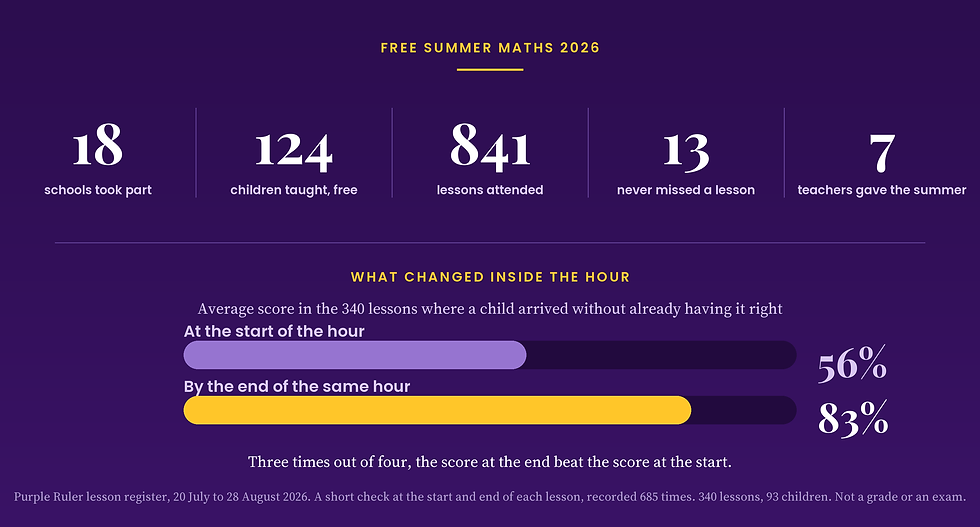
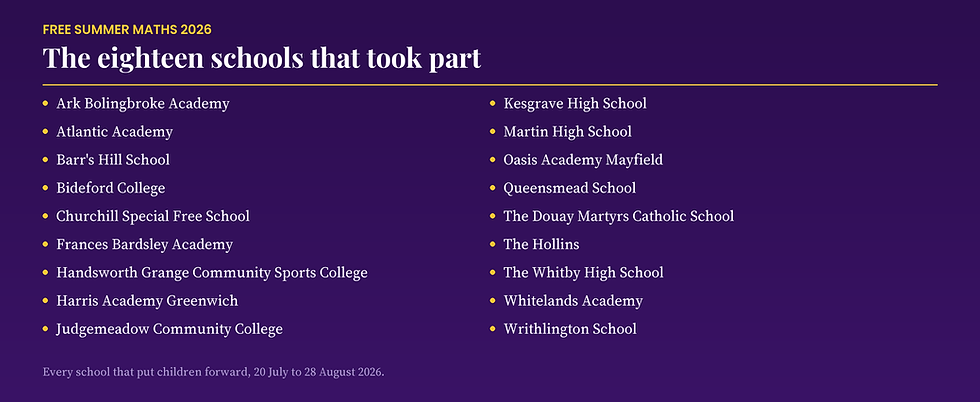
Eighteen schools put 124 children forward for free GCSE maths through the holidays. No single school had enough children to fill a class. Eighteen together did.
Between 20 July and 28 August, Purple Ruler gave away 1,258 hours of small-group GCSE maths, counted one child at a time. It cost the eighteen schools nothing and the 124 families nothing, because it was never meant to be sold.
What that looked like on the ground was this. At nine o'clock on a Tuesday morning in the middle of the summer holiday, with school shut and nobody taking a register that counted for anything, a group of children going into Year 10 and Year 11 logged in to do maths.
Six weeks is the longest stretch of the year in which a child who has fallen behind can fall further. The children who would gain most from that time are the least likely to be offered any of it, because a summer of tuition costs more than most schools and families can find.
Here is the part that made it possible, and it is the part no other provider can copy. No single school has enough children working at the same grade, free at the same hour of an August morning, to fill a class. Eighteen schools together do. A school with four children who needed this could never have staffed a class of four. It did not have to.
Behind the scenes
Children who have fallen behind in maths and know it are rarely short of willingness. They are short of a route. The gap is not really about teaching. It is about who can afford to buy a July.
Purple Ruler had the teachers, and it had the timetable space, so it gave both away. There was no charge to any school, no charge to any parent, and nothing asked in return. The only request made of the eighteen schools was that they think carefully about which children to tell.
That part matters more than it sounds. A free place is only useful if it reaches the right child, and the people who know which child that is are the heads of year who see them every day. Eighteen schools did that work for nothing too.
Children were placed by working grade into three bands, every group drew from several schools at once, and each group kept the same teacher for the whole six weeks. What they covered was ordinary GCSE ground: ratio, percentages, quadratics, circle theorems, trigonometry, probability. None of it needed to know which exam board a school had chosen, which is why eighteen schools could share a class.
What actually changed
Every lesson began and ended with the same short check, so there is a record of what each child could do at nine o'clock and what they could do an hour later.
In the 340 lessons where a child arrived without already having it right, they left with a better score three times out of four. Averaged across those lessons, children scored 56 per cent at the start of the hour and 83 per cent by the end of it. Not a grade, not an exam, and not a claim about anybody's GCSE. Just an hour in which a child who could not do something could then do it, measured, 685 times over a summer.
Who came, and how often
Thirteen children attended every one of their lessons, twelve sessions each in most cases, from the third week of July to the end of August. Fifty-two children came to three quarters or more. At one school, five of the seventeen who took a place never missed once.
Among the children who stayed with it, attendance ran at 79 per cent across the whole six weeks, in August, with nothing at all obliging them to be there.
Nothing required them to be. No register counted towards anything, no school was open, and nobody was going to ring home. They came because a teacher was expecting them and because it was helping.
What the families said
Three families tell us how the summer went.
NICK AND HIS DAUGHTER SCARLETT, IN THEIR OWN WORDS
Nick's reason for saying yes was the plainest one there is: maths was the subject his daughter was behind on, and the six-week holiday was six weeks of nothing.
It's a different teacher. She's got the same teacher at school all the time. If something doesn't make sense, it's never going to make sense, is it? NICK, SCARLETT'S FATHER
Scarlett said there was nothing to change about the programme. We asked why she would do it again nearer her exams, and she gave the answer that explains the whole thing: "I always do better when someone's teaching me than when I'm teaching myself."
Two other families wrote in during August. Both of their children were among the thirteen, each of them present for all twelve lessons.
The tutors are fun, which makes it better and more relaxed for my son to enjoy and actually want to join in. He is actually getting happy for his sessions and he is learning more, which as a parent is good to see and hear. LINDSAY, PARENT OF AYDIN
Thomas is really enjoying the programme. He loves maths and misses the structure of school, so this Summer Maths Programme has been brilliant. The tutor was excellent. KATHRYN, PARENT OF THOMAS
It gives me something to look forward to. THOMAS, STUDENT
What happens next
The children who came have something they did not have in July: six weeks of GCSE maths behind them, and a teacher who knows how they work. Thirteen of them took every hour of it.
Several of the eighteen schools have asked whether the same groups can carry on into the school year. They can. The same small-group academic tutoring runs right through term time, pooled across schools exactly as it was in August, so that a handful of children at one school is still enough to make a class.
And if a child needs a full timetable rather than one subject, that is Purple Ruler Academy, our national online school, which covers every subject for less than the same hours would cost as tutoring. Either way the next step is the same: tell us which children, and we will build the group.
We intend to run the summer again next year, for more children, in more schools. It is a modest thing, in the end, and it is meant to be.
Want to talk about next summer?
Purple Ruler, online alternative provision, tutoring, cover & high-need SEND support · purpleruler.com



Comments